
Chengdu MRJ-Laser Technology Co., Ltd is a professional supplier in the manufacturing of laser equipments in China, specialized in laser cleaning, marking, welding, machine vision and related application control system's development, production and sales. We own the first-class R&D center in optical, mechanical, circuit control and software system, with outstanding talent team and strong technical force, dedicated to provide all-around laser application solutions and laser equipment customization service to global customers.

01
Strict quality standards
All products have strictly implemented ISO9001 quality management standard and passed CE and FDA certificates. Each machine has passed strict quality inspection before delivery.
02
Personalized customized services
Professional R&D team can provide you with complete customized service for different
optical, mechanical, circuit control, hardware and software system.
03
Independent intellectual property rights
Focus on intelligent laser equipment customization, with 30 invention patents and a number of intellectual property certificates.
04
Excellent after-sale service
Two years warranty, lifetime maintenance service, implementing 24 hours online after-sale response.

what is laser welding machine
Laser welding machine is a welding device that uses a laser beam as a heat source. It uses laser pulses to heat the material in a small area, the energy then increases, and spreads rapidly to the inside of the material through heat conduction, and is able to complete the welding process of melting, evaporation, and solidification in milliseconds. Laser welding machine has a fast welding speed, deep and narrow weld, weld joints fine and firm and beautiful, etc., while its heating time is short, small heat-affected zone, small deformation, without processing treatment or simple treatment can be. It can carry out micro-welding, small workpiece resistance welding, realize automatic mass production, accurate positioning, and can weld all kinds of modeling workpieces and parts that are difficult to access by manual methods.
Laser can weld at room temperature or under special conditions, and the welding equipment is simple to install. For example: if a laser passes through an electromagnetic field, the beam will not deflect;
Laser can weld in vacuum, air and certain gas environments, and can weld through glass or materials that are transparent to the beam;
Can weld refractory materials such as titanium, quartz, etc., and can weld heterogeneous materials with good results;
After the laser is focused, the power density is high. When welding devices at high power, the aspect ratio can reach 5:1 and up to 10:1;
Micro welding can be performed. The laser beam can obtain a small spot after being focused and can be positioned accurately. It can be used in the assembly welding of micro and small workpieces produced in large quantities automatically;
The laser welding machine has a high degree of automation and a simple welding process;
Using laser welding machine to process workpieces can improve work efficiency. The finished workpieces have beautiful appearance, small weld seams, large welding depth, and high welding quality; they are non-contact operation, clean, and environmentally friendly.
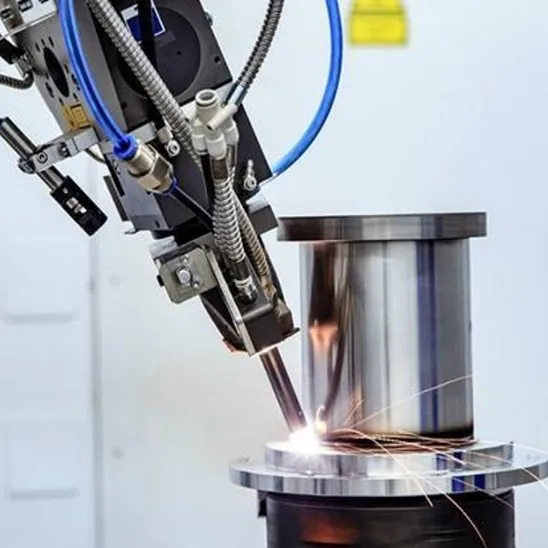
Laser welding principle
Laser welding refers to the use of high-energy-density laser beam radiation to heat the surface of the workpiece. The surface heat diffuses into the material through thermal conduction. By controlling parameters such as the width, energy, peak power, and repetition frequency of the laser pulse, the workpiece is melted to form a specific melt. Pool, thereby automatically combining workpiece materials of different materials, thicknesses, and coatings to form a single overall material. Laser welding is one of the most important technologies in industrial material processing applications. It has small weld width, high aspect ratio, small heat-affected zone, fast welding speed, smooth and beautiful welds, good toughness, no pores, and can be accurately controlled and positioned. High precision and easy to realize automation.
The handheld laser welding machine uses a handheld welding gun instead of a fixed light path. It has simple control, fast welding speed, beautiful welding seams, will not cause deformation or blackening of the workpiece, has a large welding depth, and the welding beads are uniform and firm. It can perfectly replace traditional argon arc welding and electric welding processes, with higher efficiency and no need for professional welding workers.

galvanometer laser welding machine
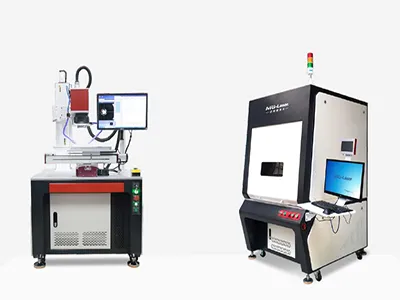
Galvanometer type laser welding machine refers to equipment that uses the F-θ lens to focus the laser on the workpiece for welding after passing through a high-speed scanning galvanometer. It has high peak power, fine spot, fast welding speed, high positioning accuracy, and small thermal deformation. , simple operation and other advantages, it is mainly suitable for processing occasions that require high welding technology, especially flat multi-point welding. Compared with the traditional stepper servo motor drive to move the workpiece for welding, galvanometer laser welding greatly reduces the idle positioning time during single-point welding, greatly improves the welding speed, and the overall production efficiency reaches ordinary About 8 times that of laser welding.
Choose the machine that suits you best.
Wide applicability
Can weld all common metal materials.
Convenient use
Handheld operation, no need complex workbench.

Easy to operate
No need professional training, low learning cost.
Not limited by the workpiece shape
Especially suitable for weld processing which with a wide variey of parts or parts are frequently changed.
Laser power density: Laser power density refers to the laser power per unit area.
Power Density(W/c㎡)=4*Laser Pulse Energy(J)/πSpot Diameter(cm)²*Pulse Width(s)Spot Diameter(mm)=[Focusing Focal Length(mm)/Laser Head Collimation Focal Length(mm)]*Optical Fiber Core Diameter(mm) 1cm=10mm=10000um
Laser power: Laser welding in the existence of a laser energy density threshold 104-106W/cm², below this value, the metal absorption of laser energy can only cause the material surface temperature increase, but maintain the solid phase unchanged, once the value is reached or exceeded, the depth of fusion will be substantially increased. Only when the laser power density on the workpiece exceeds the threshold value (material-dependent), a plasma is generated, which marks the stabilization of the depth of fusion welding. If the laser power reaches the threshold value, only surface melting occurs on the workpiece, i.e. the welding takes place in a steady heat conduction type. When the laser power density is in the vicinity of 106 W/cm², which is the critical condition for the formation of small holes, deep melting and heat conduction welding take place alternately, and the welding process becomes unstable, leading to large fluctuations in the depth of penetration. In laser deep melting welding, the laser power controls both the depth of penetration and the welding speed. The depth of weld is directly related to the beam power density and is a function of the incident beam power and beam focal spot. In general, for a given diameter of laser beam, the depth of penetration increases as the beam power increases.
Laser Pulse Width Waveform: Generally speaking, when the laser starts to act on the surface of the processed material, the reflectivity is high, and when the surface temperature of the material rises to the melting point, the reflectivity decreases rapidly. When the material surface temperature is in the melting state, the reflectivity stabilizes at a certain value. So when welding high reflective material, if a square wave is sustained (the energy required is much higher than stainless steel), the beginning of the stage of copper reflectivity is high, most of the light is reflected off, the second stage of the copper temperature increases reflectivity decreases, the copper began to absorb energy, if this time is still a very high energy, the temperature of the copper may be heated to the boiling point, resulting in the occurrence of weld instability, so it is necessary to use a pre Spike with a slow decline in the waveform.
Defocusing quantity: The defocus is the distance from the surface of the weldment to the smallest spot of the focused laser beam during welding. There are two types of defocusing: positive defocusing and negative defocusing. As shown in the figure, the focal plane located above the workpiece is positive defocusing, and vice versa is negative defocusing. Changing the amount of defocusing can change the size of the laser heating spot and the incident condition of the beam. A single defocusing amount is too large to make the spot diameter larger, reduce the power density above the spot, so that the depth of fusion is reduced. The amount of defocus not only affects the size of the spot diameter on the surface of the workpiece, but also affects the direction of beam incidence, welding mode, etc., and thus has a greater impact on the weld shape, molten pool and cross-sectional area.
Welding speed: The speed of welding affects the heat input per unit of time. If the welding speed is too slow, the heat input will be too large, resulting in burn-through of the workpiece; if the welding speed is too fast, the heat input will be too small, resulting in weld-through of the workpiece. Under a certain laser power, increase the welding speed, the heat input decreases, the weld depth decreases. Appropriate reduction of welding speed can increase the depth of fusion, but if the welding speed is too low, the depth of fusion will not increase, but rather make the melt width increase.
Protective gas: Laser welding process often use inert gases to protect the molten pool, when some materials welding does not care about the surface oxidation can not be taken into account protection, but for most applications is often used helium, argon, nitrogen and other gases for protection, so that the workpiece in the welding process from oxidation. The second role of the use of protective gases is to protect the focusing lens from metal vapor contamination and liquid droplet sputtering. Especially in high-power laser welding, because its ejecta become very strong, at this time to protect the lens is very necessary. The third role of the protective gas is to dissipate the plasma shielding generated by high-power laser welding is very effective. The metal vapor absorbs the laser beam and ionizes into a plasma cloud, and the protective gas around the metal vapor also ionizes due to heat. If too much plasma is present, the laser beam is consumed to some extent by the plasma. The plasma is present on the work surface as a second source of energy, making the depth of fusion shallower and the weld pool surface wider. The effect of the plasma cloud on the depth of melt is most pronounced in the low welding speed zone. Its effect diminishes when the welding speed is increased.
Welding Materials: The absorption of the laser beam by the material depends on some important properties of the material, such as absorption rate, reflectivity, thermal conductivity, melting temperature, evaporation temperature and so on, of which the most important is the absorption rate. Factors affecting the material's absorption of the laser beam include two aspects: firstly, the material's electrical resistance coefficient, after measuring the absorption rate of the polished surface of the material, it is found that the material's absorption rate is proportional to the square root of the electrical resistance coefficient, which varies with the temperature; secondly, the surface state of the material (or the degree of finish) has a more important effect on the beam's absorption rate, which will have a significant effect on the welding effect.
Metal industry
Laser welding machine is mainly used for welding metal, welding speed, high quality weld, welding a wide range of welding, whether it is a material between the welding, or a variety of materials between the welding, such as steel, aluminum, copper, magnesium alloy, titanium alloy.

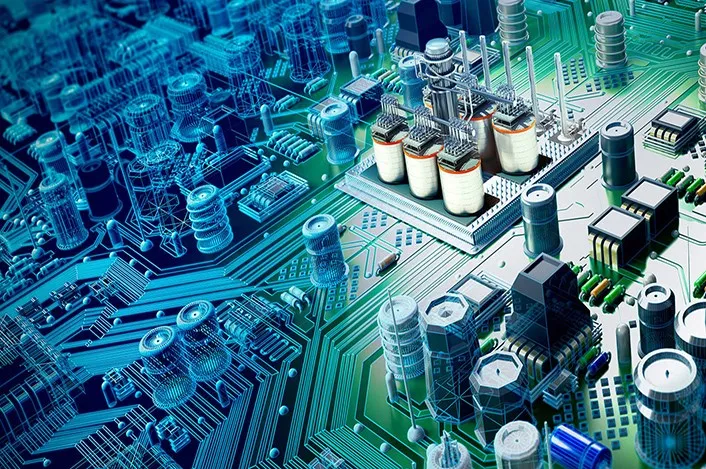
Electronics industry
Laser welding machine is mainly used for welding microelectronic components, laser beam aggregation point of light is small, small heat-affected zone, you can ensure that the welding quality of electronic components and welding stability, such as digital products, batteries, transformers, integrated circuits, and cell phones, computers and other products shell.
Mold industry
In the mold welding, laser welding machine has a unique advantage, the use of laser beam welding on the material has little impact on the resulting deformation of the material is small, less cracks, such as casting molds, stamping molds, plastic molds, rubber molds and so on.


Hardware industry
Laser welding machine welding completed with a good appearance, in the kitchen supplies, sanitary ware and other daily products are quite popular, such as plumbing fittings, door knobs, doors and windows, stainless steel kitchen utensils and so on.
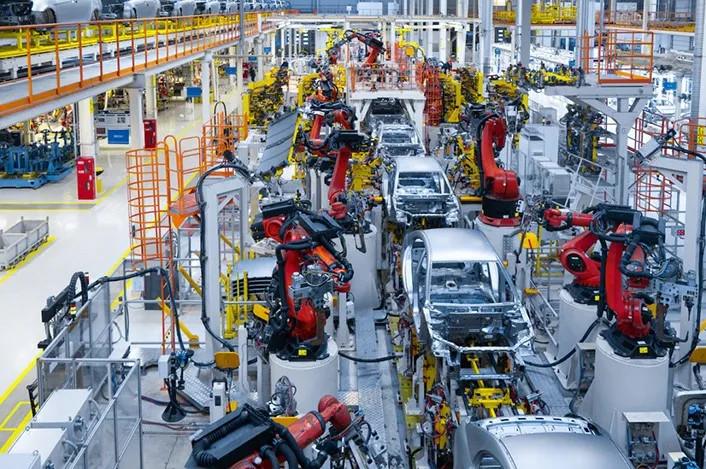
Automotive industry
Laser welding machine energy concentration, reliable welding quality, suitable for high-end consumer products production needs, the use of welding, lap welding, sealing welding and other welding methods can be welded car body, chassis, engine, parts and other components.

Jewelry industry
Laser welding machine welding high precision, small weld joints, very suitable for precious tiny products to achieve precision welding, not only small weld seam, and does not require solder, can be flexible to weld a variety of conventional shapes as well as customized shapes, such as gold jewelry, silver jewelry, and so on.
We sincerely welcome friends from all over the world to cooperate with us on the basis of long-term mutual benefits. Look forward to receiving your enquiries soon.
Our address
Bldg 10, No.28, Xinchuang Rd, West Zone, High-tech Zone, Chengdu, China
Phone Number
+86 18382288239
kinsley@mrj-lasermark.com

FAQ

01. What are the applications of welding?
Welding is a simple, economical, and affordable process that creates strong, durable, and permanent joints between metals, thermoplastics, or wood. It's used in many industries, including:
02. What are the applications of spot welding machine?
03. How does a laser welding machine work?
Laser welding uses a high-energy laser beam to melt and fuse metals together to create a strong bond. The process involves the following steps:
1. Focus the beam
The laser beam is concentrated onto the weld joint between the materials being joined.
2. Melt the materials
The heat from the laser beam causes the metal to melt and form a localized pool.
3. Move the beam
The laser beam is then moved along the surface of the joint, melting a leading edge and leaving a molten trailing edge to cool and solidify.
4. Solidify
The molten material solidifies along the path of the laser beam, creating a sturdy weld.
04. Where can laser welding be used?
05. Do laser welders need gas?
06. How long do laser welders last?
